
Lottery draw dates across timezones: keep the source date and offset
The same instant can appear on two different calendar dates after a timezone conversion. A UTC date in a spreadsheet does not automatically replace the draw date printed by the result source. Keep both the original event label and any converted timestamp.
This guide in the jlbet lottery section uses an invented timestamp close to midnight. It explains how to retain date context when copying records, rather than verifying an actual lottery schedule or result.
One instant, two calendar dates
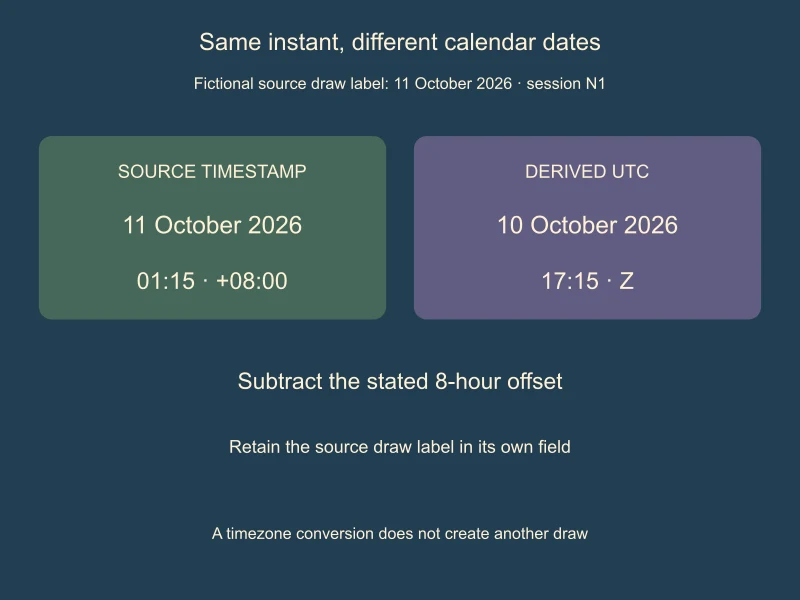
Suppose a fictional result source labels a record “11 October 2026, session N1” and supplies the timestamp 2026-10-11T01:15:00+08:00. The offset +08:00 means the displayed local time is eight hours ahead of UTC. Subtract eight hours to obtain 2026-10-10T17:15:00Z.
Those two timestamps represent the same instant. The local calendar date is 11 October; the UTC calendar date is 10 October. If the source uses its local date and session as the draw label, rewriting that label as “10 October, N1” would change the record’s identity without support.
| Field in the fictional record | Value | Purpose |
|---|---|---|
| Source draw label | 11 October 2026, session N1 | Retain the source’s event identity |
| Source timestamp | 2026-10-11T01:15:00+08:00 | Original date, time and explicit offset |
| Derived UTC timestamp | 2026-10-10T17:15:00Z | Same instant in a common comparison zone |
| Copied-at timestamp | A separate, recorded value | When the record was retrieved, not when the draw occurred |
Read the offset before converting
RFC 3339’s date-and-time specification defines a year-month-day timestamp with a time and UTC offset; Z represents UTC. Its offset convention allows the local time to be converted to UTC by subtracting the stated offset. These are timestamp semantics, not a lottery rule.
The example uses the explicitly supplied +08:00 value. It does not derive that offset from the website’s domain, language, your computer’s clock or where the reader lives. If an actual record gives only “01:15” with no established zone, do not append Z or +08:00 as a guess.
A named timezone may require rules about daylight saving and date. An explicit numeric offset describes the offset supplied for that timestamp; it does not establish the source’s future scheduling rules. Keep the observed value rather than assuming every record shares it.
A slash date can be ambiguous before any conversion
The copied text 03/04/2026 can mean 3 April under day/month/year formatting or March 4 under month/day/year formatting. Both interpretations form valid dates. A spreadsheet accepting one does not prove that the source intended it.
Keep “03/04/2026” in the raw-date field until the source’s format has been established. If it is verified as day/month/year, a separate normalized date can be 2026-04-03. If it is month/day/year, it becomes 2026-03-04. Do not silently choose based on the application’s current locale.
Match event fields before deduplicating
If two copies of the same fictional event have identical product and draw identifiers, and their timestamps convert to the same instant, they may be duplicate representations of that event. Preserve their provenance and keep one event in the comparison dataset after confirming the identifiers.
A shared instant alone is not a complete draw key: two products can have events at the same time. A shared date alone is weaker still, because one product may have several sessions. Use the source’s product, draw identifier and session fields alongside the timestamp.
Do not mix result time with the page’s clock
A page can show when it was updated or when you copied it without stating the draw’s timestamp. Label those fields according to their actual meaning. A retrieval on 11 October does not make a retained result from 10 October a new draw.
If the source supplies only a draw date, preserve that date as a date. Do not manufacture a midnight timestamp and treat it as a verified event time. The offset conversion in this guide is available because the fictional record includes a full time and explicit offset.
Keep raw and comparison fields in the spreadsheet
The existing guide to preserving lotto text fields and number sequence explains why a copied combination should not be allowed to turn into a date or lose a leading zero. Apply the same separation here: retain the original date text, verified format, original timestamp, derived timestamp and draw label as different fields.
A useful summary for the example is “source label: 11 October N1; source time: 01:15 +08:00; derived UTC: 10 October 17:15.” Another reader can then reproduce the conversion without mistaking the UTC date for a changed result row.
Source and timestamp arithmetic checked on 10 October 2026. All event labels and timestamps used as lottery records are fictional. This guide verifies no real draw, acceptance deadline or claim entitlement.