
Sticky Wild counters: three rounds can contain eight tumbles
Published — UTC

“Remains for three rounds” is not the same as “remains for three cascades.” A persistent symbol’s counter needs its own unit. Counting every animation step as a new round can remove the symbol too early in a written explanation.
State when the counter changes
In this invented rule, a Wild is locked before round A and remains through three completed rounds: A, B and C. The counter decreases after each completed round. Tumbles within a round do not decrease it. The Wild is removed before round D.
| Event | Tumbles in that round | Rounds remaining after completion |
|---|---|---|
| Round A | 4 | 2 |
| Round B | 1 | 1 |
| Round C | 3 | 0 |
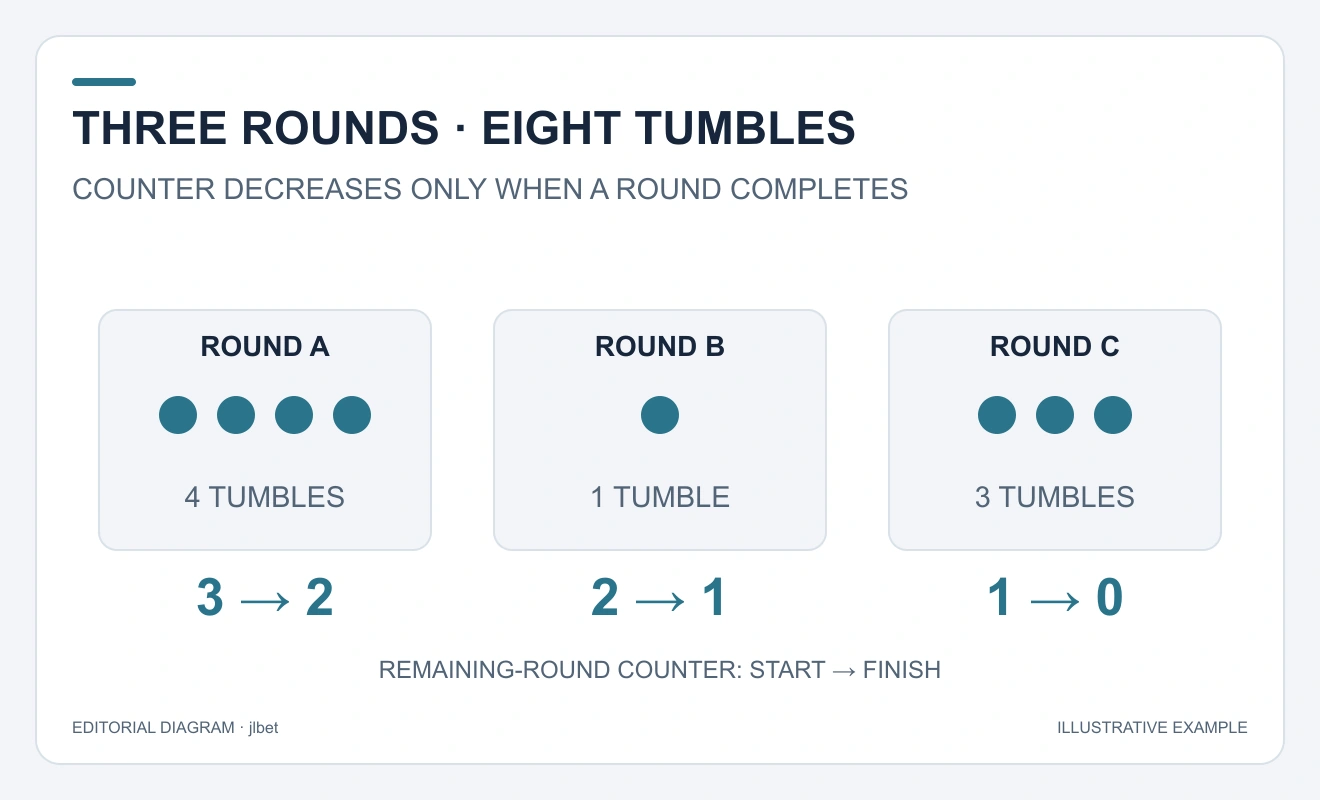
Eight tumbles occurred, but only three lifetime units were consumed. During A’s fourth tumble the symbol is still present under the stated rule. That conclusion comes from the lifetime definition, not the word “sticky” alone.
Distinguish a lock from a retrigger
If a later event refreshes a counter, its rule must say whether it resets the value, adds units or creates another symbol. A reset from 1 to 3 adds two remaining units; it does not mean three units were added to the old one.
Also check whether a symbol remains at a position or follows a moving symbol object. A grid expansion can make that distinction visible, but the artwork alone cannot establish it.
What the real documentation must supply
Pragmatic Play’s announcement for The Dog House Megaways names separate Sticky Wilds and Raining Wilds modes. That is a concrete reason to retain the mode name when reading rules. It does not establish the three-round lifetime used in our invented example or confirm availability on this website.
Log the boundary, not every visual effect
A useful state record has five fields: round identifier, counter before the round, number of tumbles, counter after the round, and any separate refresh event. For round A those values are A, 3, 4, 2 and none. Four animations do not justify four decrements when the specified boundary is round completion.
The initial state matters too. Our rule locks the Wild before A and includes A in its three-round lifetime. Wording such as “the next three rounds after this one” would describe a different duration. Avoid an off-by-one error by writing down whether the triggering round is included.
Reset and add produce different future states
Suppose one round remains when a new event occurs. “Reset to 3” gives a new counter of 3. “Add 3” gives 4. If the display shows 3 afterwards, that observation is consistent with a reset but does not by itself prove why the event happened. Keep the triggering condition and the counter operation as separate fields.
A limit can introduce another condition: an “add 3, capped at 3” instruction also ends at 3 from a starting value of 1. Without the cap wording, the same displayed counter could be explained incorrectly. The example does not assert that any named game uses such a cap.
Persistence does not imply a win
A Wild can remain present while the other symbols fail to create an eligible combination. Track “still locked” independently from “used in this award”. For a disputed history entry, preserve the mode, round IDs and before/after states, then identify the specific boundary that disagrees with the published rule. A long animation or an unchanged star icon alone is not enough to establish a settlement error.